 Slow Bio Hack

Introduction to Music Therapy for Cognitive Enhancement
In 2026, music therapy has evolved into a precise, evidence-based method for enhancing cognitive performance, offering far more than casual listening or popular binaural beats apps. This field combines neuroscience, personalized audio engineering, and daily habit integration to support focus, memory retention, emotional regulation, and long-term mental resilience. Professionals, students, and biohackers alike are turning to these protocols as a non-invasive alternative or complement to traditional methods. The emphasis on 2026 trends highlights how wearable sensors and AI now tailor auditory experiences in real time, creating adaptive sessions that respond to individual brain activity for sustained productivity and reduced mental fatigue.
The Science of Rhythm Entrainment
Rhythm entrainment refers to the brain's natural tendency to synchronize its electrical rhythms with external auditory stimuli, such as steady beats or melodic patterns. This process influences key brainwave states: alpha waves for relaxed alertness, theta for creative insight, and beta for active problem-solving. Detailed studies from the National Institutes of Health demonstrate how specific tempos can modulate neural oscillations, improving attention spans and reducing cortisol levels during high-pressure tasks. In practice, entrainment works by delivering consistent pulses that guide the brain into optimal states without conscious effort from the listener. Advanced 2026 protocols incorporate EEG feedback loops, where headphones adjust frequencies based on live brain data to maintain entrainment even as mental states fluctuate throughout the day.
Understanding the underlying mechanisms helps users select effective tracks. For instance, isochronic tones at 10 Hz can boost alpha activity, while gamma-range pulses around 40 Hz support higher-order cognition. These effects build cumulatively with regular use, leading to improved baseline focus over weeks.
Curating Playlists for Specific Cognitive Tasks
Playlist curation demands careful attention to tempo, instrumentation, harmonic structure, and dynamic variation. For deep analytical work, prioritize 55-70 BPM tracks featuring minimal percussion and sustained tones in minor or modal keys. Creative brainstorming sessions benefit from 75-95 BPM selections with evolving melodies and subtle harmonic shifts. High-intensity focus periods pair well with 100-120 BPM electronic or orchestral pieces that maintain energy without overwhelming the listener.
Practical steps for building effective playlists include:
- Begin by defining the cognitive goal and estimated duration of the task.
- Analyze track metadata using reliable tools to confirm BPM, key signature, and energy levels.
- Incorporate 5-10 minute blocks of consistent rhythm followed by brief transitional silences to reset attention.
- Test combinations during low-stakes sessions and adjust based on self-reported focus and output quality.
- Rotate genres seasonally to prevent habituation, drawing from classical, ambient electronic, and world music traditions.
Examples of task-specific playlists might feature Baroque compositions for logical reasoning or modern ambient artists for prolonged writing sessions. Always prioritize instrumental tracks to minimize lyrical distractions.
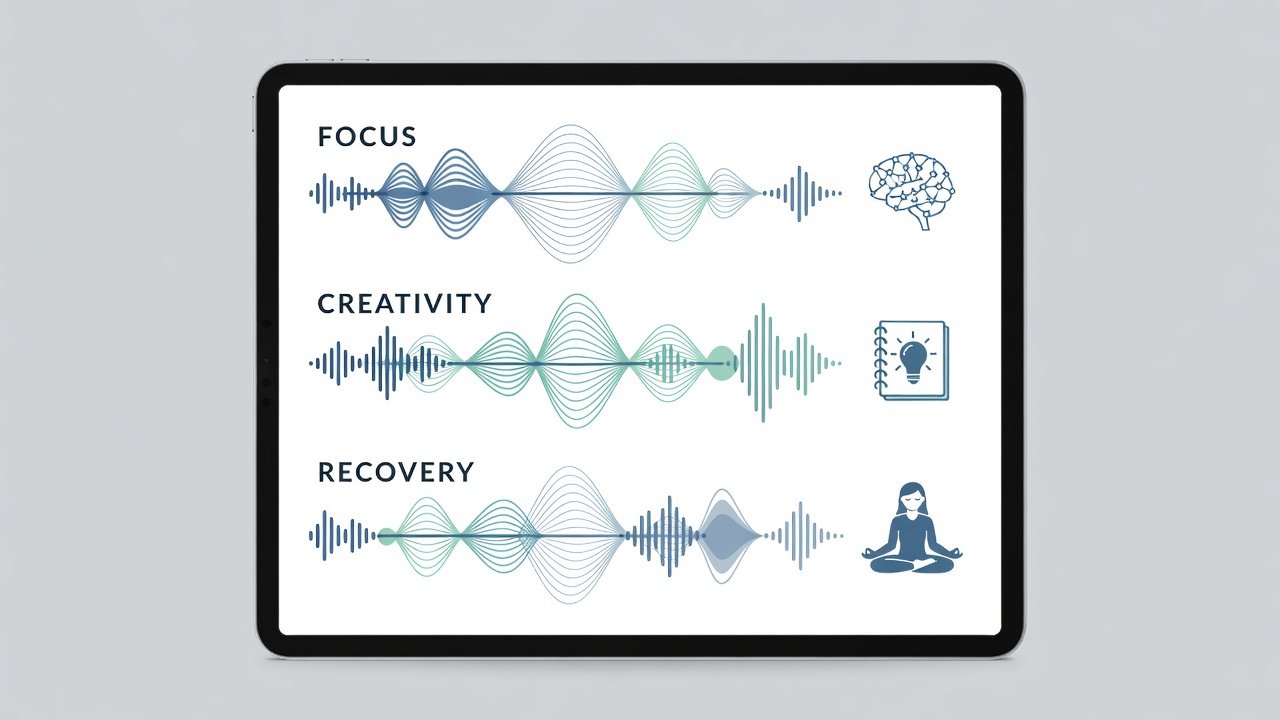
Integrating Music Therapy into Daily Routines
Seamless integration starts with anchoring sessions to existing habits. Morning protocols of 15-25 minutes using mid-tempo entrainment tracks can prime the brain for peak performance during commutes or initial work blocks. Midday resets employ shorter 10-minute alpha-wave segments to combat post-lunch dips. Evening routines focus on descending tempos to facilitate recovery and improve sleep architecture, which indirectly enhances next-day cognition. Professionals in demanding fields, such as software engineering or finance, often schedule music blocks around project milestones, while students align playlists with study pomodoros. Tracking integration success involves simple metrics like task completion rates and subjective energy scores logged in a dedicated journal or app.
Comparing Music Therapy to Meditation and Nootropics
Music therapy offers immediate physiological effects through entrainment, contrasting with meditation's requirement for extended skill development. While meditation builds long-term mindfulness, auditory protocols deliver consistent results from the first session with lower barriers to entry. In comparison to nootropics, music avoids metabolic side effects and interactions, making it suitable for daily use across diverse populations. Many individuals stack approaches—using music during meditation or alongside mild cognitive supplements—for compounded benefits. The non-invasive nature of music therapy also supports broader accessibility, particularly for those sensitive to pharmacological interventions.
Practical Steps for Beginners in 2026
New users should invest in comfortable, noise-isolating headphones first. Begin with publicly available entrainment libraries to experiment before committing to subscription services. Establish a baseline by completing simple cognitive tests before and after short sessions. Progress to personalized programs that incorporate user feedback loops. Common pitfalls include over-relying on high volumes or inconsistent scheduling; mitigate these by setting volume limits and calendar reminders. Over four to six weeks, most beginners notice measurable improvements in sustained attention and stress resilience.
Real-World Case Examples
A freelance graphic designer implemented morning rhythm entrainment and reported sharper visual processing alongside fewer creative blocks during client deadlines. A graduate researcher used customized focus playlists during literature reviews, achieving faster synthesis of complex papers and lower anxiety before presentations. In a corporate setting, a marketing team adopted group music protocols for collaborative workshops, resulting in higher idea generation and improved team cohesion metrics over a three-month pilot. These cases illustrate how protocols adapt across contexts while delivering tangible cognitive gains.
2026 Trends in Personalized Audio Technology
Emerging technologies feature AI algorithms that refine entrainment parameters based on biometric data from wearables. Integration with home automation systems enables automatic transitions between focus, recovery, and creative modes. The World Health Organization continues to recognize auditory health interventions as valuable for population-level mental well-being, supporting broader adoption. Future developments may include neural interface headsets that deliver hyper-personalized frequencies, further blurring lines between therapy and everyday optimization tools.
Common Mistakes to Avoid
Users often select tracks based solely on personal taste rather than acoustic properties, reducing effectiveness. Another frequent error involves neglecting volume consistency or failing to incorporate rest periods, leading to auditory fatigue. Beginners sometimes expect instant mastery without iterative testing and adjustment. Avoiding these issues requires education on entrainment principles and disciplined experimentation.
FAQ: Addressing Common Misconceptions
Does music therapy work equally for all age groups?
Benefits appear across demographics, though younger adults often adapt faster due to greater neuroplasticity, while older users may require longer adjustment periods for optimal entrainment.
Is specialized equipment necessary?
Basic headphones suffice for beginners, but advanced 2026 systems with biofeedback provide superior personalization for serious practitioners.
Can music therapy fully replace traditional focus methods?
It serves as a powerful complement rather than complete replacement, enhancing outcomes when combined thoughtfully with other strategies.
How long until results become noticeable?
Many experience acute focus improvements within the first session, with cumulative cognitive resilience developing over consistent two-to-four-week use.
Conclusion
Music therapy protocols stand as a robust, science-supported avenue for cognitive optimization in 2026. Through deep understanding of entrainment, intentional playlist design, and thoughtful routine integration, individuals gain practical tools for enhanced focus and mental endurance. Experimentation with these methods, supported by ongoing technological advances, empowers users to build personalized systems that deliver lasting performance benefits.
No comments yet. Be the first!