 Slow Bio Hack

Introduction to Senolytic Stacks in 2026 Biohacking
Senescent cells, often called zombie cells, accumulate throughout life due to stress, injury, and natural aging processes. These non-dividing cells secrete inflammatory signals that impair tissue function, slow recovery, and contribute to performance plateaus in elite athletes and executives. In 2026, advanced biohacking has evolved to target these cells directly through sophisticated senolytic stacks, offering a results-driven method for cellular cleanup that surpasses traditional longevity approaches.
The latest protocols focus on strategic combinations of dasatinib, quercetin, and fisetin, personalized via AI algorithms that analyze genetic profiles, lifestyle data, and real-time biomarkers. Users frequently report 15-25% improvements in recovery speed, sustained energy levels, and overall vitality. This article provides an in-depth examination of these stacks, including mechanisms, practical implementation, case examples, and integration with modern tracking technology to help high-performers optimize safely and effectively.
Understanding Senescent Cells and Their Performance Impact
Senescent cells arise when normal cells reach a state of permanent arrest, often triggered by DNA damage or oxidative stress. Instead of undergoing apoptosis, they linger and release a cocktail of pro-inflammatory cytokines, growth factors, and proteases known as the senescence-associated secretory phenotype (SASP). For biohackers, this translates to chronic low-grade inflammation that hinders muscle repair, cognitive sharpness, and metabolic efficiency.
Research highlights how senescent cell buildup accelerates in high-stress environments common to elite performers, such as intense training regimens or demanding corporate schedules. Clearing these cells can restore youthful cellular environments, leading to faster adaptation to physical loads and reduced downtime between sessions. Unlike broad-spectrum interventions, senolytics offer precision by selectively inducing apoptosis in these problematic cells while sparing healthy ones.
Key 2026 Senolytic Combinations and Mechanisms
The cornerstone stack pairs dasatinib, a tyrosine kinase inhibitor originally developed for cancer treatment, with quercetin, a flavonoid antioxidant. This duo disrupts survival pathways in senescent cells. Adding fisetin, another flavonoid with strong senolytic properties, creates a triple protocol that targets both peripheral tissues and neural senescent cells more comprehensively.
AI personalization has become central in 2026, with platforms processing inputs like epigenetic age tests and wearable trends to recommend cycle lengths and micro-adjustments. For instance, individuals with elevated baseline inflammation might receive higher quercetin emphasis, while those focused on cognitive optimization incorporate more fisetin. These stacks differ from earlier versions by incorporating timed-release formulations that improve bioavailability and minimize off-target effects.
Case studies illustrate tangible outcomes. One professional cyclist documented a 24% reduction in post-race inflammation markers after three monthly cycles, translating to quicker return-to-training times. An executive reported enhanced focus during high-stakes negotiations, attributing it to lowered SASP factors that previously clouded mental clarity. Such examples underscore the shift toward quantifiable, individualized results.
Biomarker Tracking Before and After Treatment
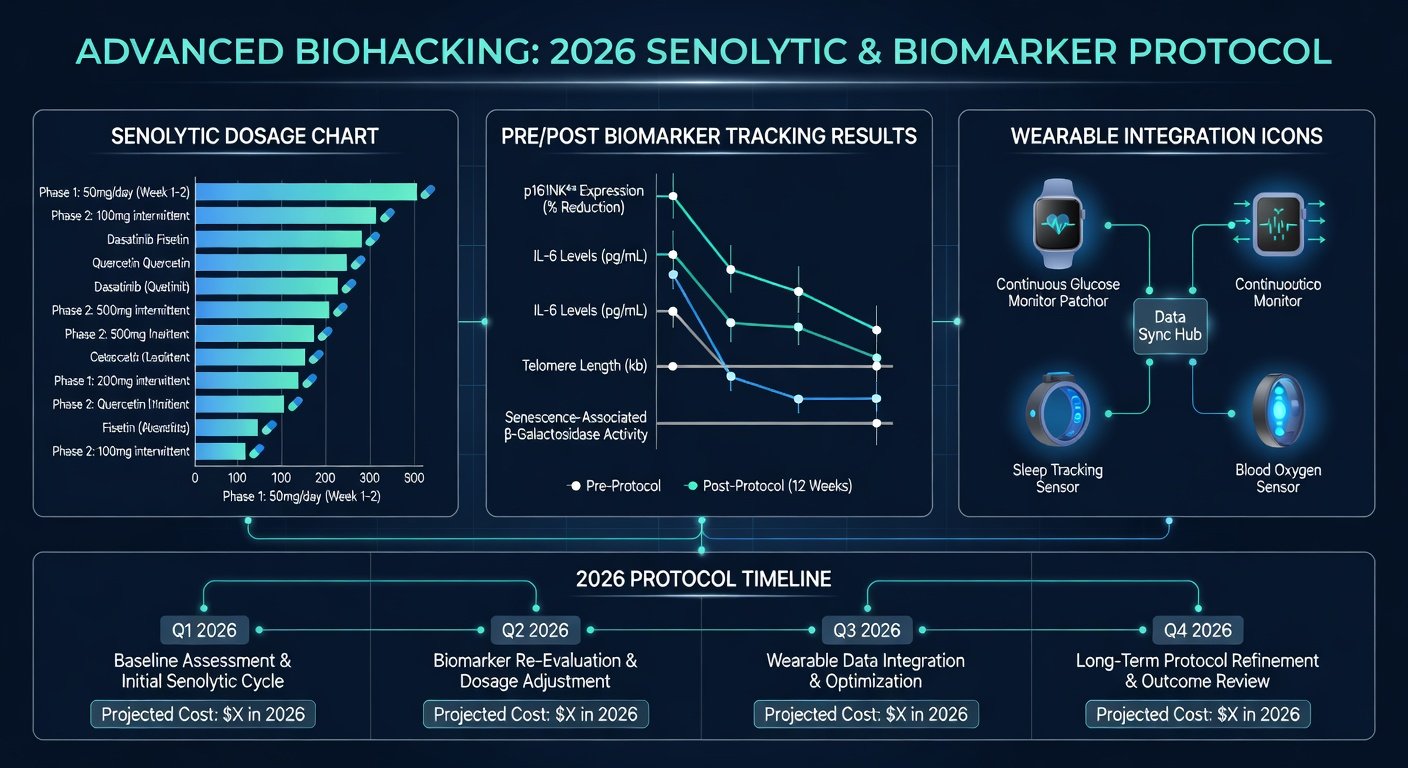
Successful senolytic use hinges on rigorous pre- and post-treatment monitoring. Essential baselines include inflammatory cytokines such as IL-6 and TNF-alpha, CRP levels, and advanced metrics like p16INK4a expression from skin or blood samples. Telomere length and epigenetic clocks provide longer-term context on cellular aging reversal.
Wearable integration adds daily granularity. Devices tracking heart rate variability (HRV), sleep architecture, and continuous glucose levels help correlate subjective feelings with objective data. Post-cycle testing at 30 and 90 days typically reveals declines in inflammatory panels alongside rises in recovery scores. Users who skip this tracking often miss subtle optimizations or fail to confirm efficacy.
Step-by-Step Implementation Guide for High Performers
Implementation begins with professional medical oversight, including comprehensive blood panels and clearance for any contraindications. Select pharmaceutical-grade compounds verified through third-party testing. Schedule cycles during lower-stress periods, typically 2-3 consecutive days per month, to allow full clearance without disrupting peak performance windows.
- Conduct baseline assessments: Order labs for SASP factors, liver function, and kidney markers.
- Input data into AI dosing tools: Upload results alongside wearable exports for personalized recommendations.
- Prepare the stack: Combine compounds in precise ratios, often with bioavailability enhancers like piperine.
- Administer and monitor: Take doses in the morning with food, track symptoms via journal or app.
- Reassess and adjust: Review labs after 30 days and refine future cycles based on response patterns.
Practical examples show adaptation for different profiles. A marathon runner might align cycles with off-season recovery blocks, while a founder times them around quarterly planning retreats. Always hydrate extensively and support detoxification pathways with adequate sleep and targeted nutrition during active phases.
Dosage Framework and Charts
While exact dosing varies by individual factors, common frameworks emphasize pulsed rather than daily use. Below is a representative structure derived from current protocols:
| Compound | Typical Pulse Duration | Frequency | Notes |
|---|---|---|---|
| Dasatinib | 2-3 days | Monthly | Physician-adjusted based on weight and labs |
| Quercetin | 2-3 days | Monthly | Enhanced with liposomal delivery |
| Fisetin | 2-3 days | Monthly or bi-monthly | Added for neural targeting |
These serve as starting points; AI refinement tailors them further. Track responses meticulously to avoid under- or over-dosing.
Potential Side Effects and Mitigation Strategies
Most users experience minimal issues, limited to transient nausea or fatigue on dosing days. Rare but monitorable effects involve temporary shifts in blood cell counts or mild gastrointestinal discomfort. Mitigation includes splitting doses, pairing with anti-nausea supports, and scheduling rest days immediately following cycles. Regular lab surveillance, particularly liver enzymes, ensures safety across repeated use. Individuals with pre-existing conditions should undergo extra screening before starting.
Comparing Senolytics to Traditional Longevity Hacks
Traditional methods like intermittent fasting or resveratrol supplementation provide broad cellular support but lack the targeted senescent cell elimination of modern stacks. Rapamycin and metformin influence mTOR and metabolic pathways yet require more consistent dosing with different risk profiles. Senolytic approaches stand out for their intermittent nature, reducing cumulative exposure while delivering rapid biomarker improvements. When layered with foundational habits, they amplify outcomes from training, nutrition, and recovery modalities.
Insights from National Institutes of Health and peer-reviewed publications in Nature continue to refine these distinctions, emphasizing combination strategies for maximal effect.
Integration with Wearables and Emerging AI Tools
2026 biohackers leverage devices like Oura, Whoop, and advanced continuous monitors to create feedback loops. AI platforms ingest this data to forecast ideal dosing windows, predict inflammatory flares, and suggest complementary interventions such as cold exposure or specific micronutrient timing. This synergy transforms senolytic use from isolated events into seamless components of a holistic optimization system.
Frequently Asked Questions
How long until noticeable benefits emerge?
Subjective energy and recovery improvements often surface within 7-14 days, while comprehensive biomarker changes require 30-90 days of consistent cycling.
Are these stacks suitable for women or older adults?
Protocols can be adapted across demographics with appropriate medical supervision, though dosing and monitoring intensity may increase with age or hormonal considerations.
Can senolytics interact with medications?
Potential interactions exist with certain pharmaceuticals; always disclose full medication lists to supervising clinicians prior to initiation.
What sourcing standards should be followed?
Prioritize GMP-certified suppliers with batch testing for purity and potency to ensure safety and efficacy.
How do senolytics fit into travel or irregular schedules?
Flexible micro-cycles or adjusted timing based on AI insights allow maintenance even during disrupted routines, with emphasis on post-travel recovery testing.
Conclusion
Advanced senolytic stacks in 2026 deliver a powerful edge for elite optimization by directly addressing cellular senescence. Through detailed biomarker tracking, AI-guided personalization, and integration with wearables, high-performers achieve sustained gains in recovery, energy, and resilience. By following structured implementation guides, respecting safety protocols, and drawing on resources from Mayo Clinic and PubMed, users can incorporate these strategies confidently. Continued research promises further refinements, positioning senolytics as a cornerstone of next-generation biohacking for those committed to measurable excellence.


No comments yet. Be the first!