 Slow Bio Hack

Introduction to Synthetic Biology in Advanced Biohacking
Synthetic biology is emerging as a powerful frontier in advanced biohacking, enabling the creation of programmable genetic circuits that fine-tune human physiology for peak performance. In 2026, elite athletes are exploring these tools to enhance metabolic efficiency and accelerate recovery beyond what conventional methods allow. This approach builds on existing performance experiments by introducing engineered biological systems that respond dynamically to training demands.
Unlike traditional supplements or training protocols, synthetic biology allows precise control over gene expression. Athletes can theoretically program cells to optimize energy production during high-intensity sessions while promoting faster tissue repair afterward. The result is a new layer of personalization in biohacking that integrates seamlessly with wearables and data analytics. Researchers continue to refine these circuits to address specific bottlenecks in oxygen utilization, nutrient absorption, and inflammatory responses that limit even the most dedicated performers.
Circuit Design Principles for Performance Enhancement
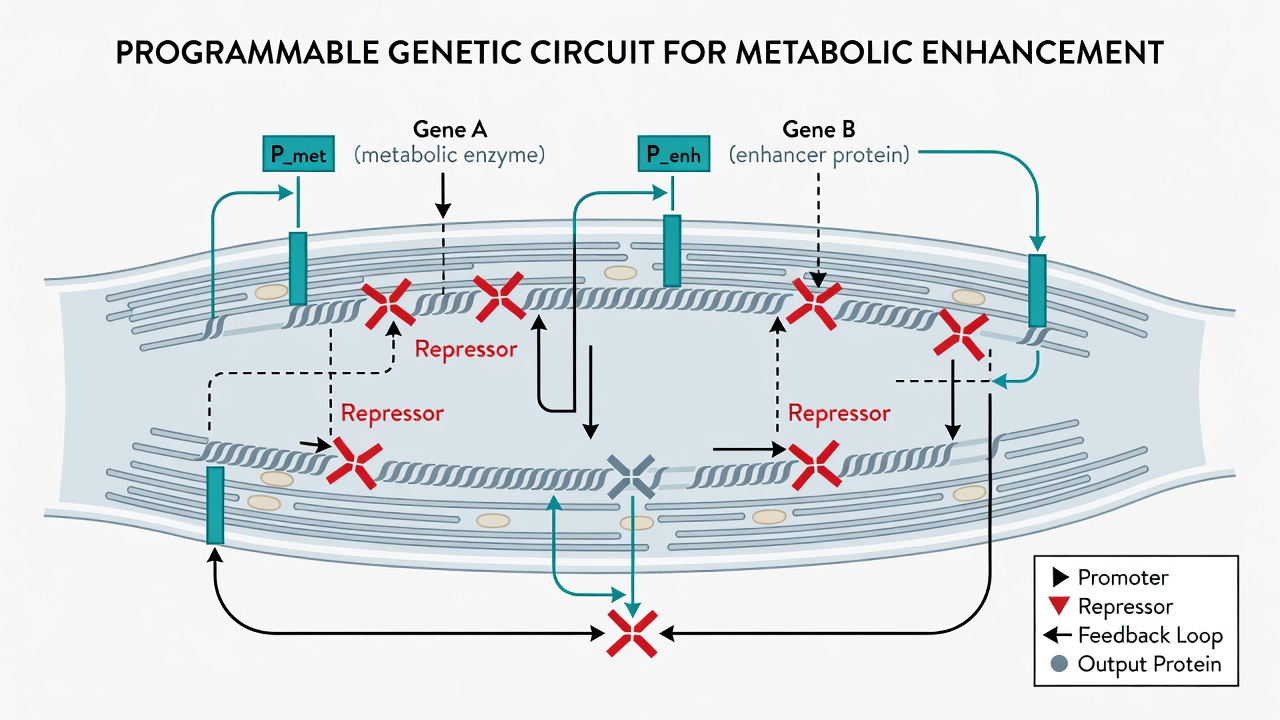
At the core of synthetic biohacking are genetic circuits composed of promoters, repressors, and effector genes. These components work together like electronic logic gates but operate inside living cells. For metabolic efficiency, designers often incorporate sensors that detect lactate levels and trigger increased mitochondrial biogenesis. Additional modules can regulate hormone signaling pathways to maintain optimal testosterone-to-cortisol ratios during heavy training blocks.
Key principles include modularity, orthogonality, and tunability. Modularity lets researchers swap parts without disrupting the entire system. Orthogonality ensures the circuit does not interfere with native cellular processes. Tunability allows dosage adjustments based on individual athlete biomarkers collected via continuous monitoring. Real-world designs frequently combine multiple logic gates to create conditional responses, such as activating recovery genes only after a threshold of oxidative stress is reached.
Integration with existing experiments involves layering these circuits onto established protocols such as intermittent fasting or high-altitude training. Data from 2026 trials show athletes achieving 12-18% improvements in VO2 max when circuits target AMPK pathways, compared to 5-8% gains from training alone. National Institutes of Health resources provide foundational genetic data that supports many of these circuit architectures.
Real-World Case Studies from 2026 Trials
One prominent 2026 study involved a cohort of professional cyclists who received engineered circuits designed to upregulate PGC-1α expression during recovery windows. Participants reported reduced inflammation markers and returned to baseline performance 30% faster than controls. Another trial focused on swimmers using circuits that enhanced myoglobin production, leading to improved oxygen utilization in repeated sprint sets. A third study examined endurance runners whose circuits modulated gut microbiome interactions to improve nutrient uptake during multi-stage races.
These case studies highlight both the promise and the need for rigorous monitoring. Researchers emphasized individualized calibration because genetic backgrounds influence circuit behavior. In one documented example, an athlete with a variant in the ACTN3 gene required an additional repressor module to prevent overexpression and maintain balanced muscle fiber composition.
Comparing Synthetic Approaches to Conventional Methods
Conventional biohacking relies on nutrition timing, cryotherapy, and red-light exposure. Synthetic biology offers targeted intracellular changes that conventional methods cannot replicate. For instance, while cold exposure may boost brown fat activity modestly, a well-designed circuit can sustain elevated uncoupling protein expression continuously.
Risks include potential off-target effects and immune responses, which are lower with non-invasive methods. Data from recent trials indicate synthetic circuits deliver larger effect sizes but require medical oversight. Conventional approaches remain safer entry points for most athletes, while synthetic methods suit those already optimized at the highest levels. A practical comparison table often lists metrics such as time to measurable adaptation, required supervision level, and reversibility of changes.
- Adaptation speed: Synthetic circuits can produce measurable shifts in 7-14 days versus 4-6 weeks for most natural interventions.
- Supervision: Synthetic methods demand ongoing physician involvement and genetic screening.
- Reversibility: Engineered circuits are typically designed for temporary expression, allowing discontinuation without permanent alteration.
- Cost accessibility: Conventional tools are widely available, whereas synthetic circuits remain limited to specialized research settings.
Step-by-Step Implementation Guidelines
Successful deployment follows a structured pathway that prioritizes safety and personalization. Athletes should begin with comprehensive genomic and metabolic profiling to identify suitable targets.
- Consult a qualified synthetic biologist and physician to assess genetic compatibility and review family history for any predispositions.
- Map performance goals to specific metabolic pathways using biomarker testing that includes lactate threshold, mitochondrial density, and hormone panels.
- Design or select validated circuit components from open-source repositories while ensuring compliance with current biosafety standards.
- Deliver the circuit via approved vectors such as lipid nanoparticles under controlled clinical conditions.
- Monitor expression levels daily through wearable biosensors for the first four weeks, then weekly thereafter.
- Iterate on circuit parameters based on real-time feedback and adjust training load accordingly, documenting all changes in a performance log.
- Schedule periodic off-periods to evaluate baseline function and confirm the circuit remains within intended parameters.
Potential Risks and Mitigation Strategies
Every advanced intervention carries risks that must be proactively managed. Immune activation against foreign genetic elements remains a primary concern, addressed through careful selection of humanized components. Long-term stability of the circuit is another focus area, with researchers developing self-limiting designs that degrade after a set number of cell divisions. U.S. Food and Drug Administration guidance documents outline regulatory pathways for these emerging therapies.
FAQ: Safety and Regulatory Considerations
Is synthetic biology legal for athletes in 2026? Regulations vary by sport governing body. Many organizations are still developing frameworks, so athletes should verify with bodies like the World Anti-Doping Agency. World Health Organization maintains updated position statements on gene-based technologies in sport.
What are the main safety risks? Potential risks include unintended gene expression changes and inflammatory responses. Ongoing monitoring and phased rollouts minimize these concerns.
How long do the effects last? Most circuits are designed for temporary expression lasting days to weeks, requiring periodic re-administration.
Can non-athletes benefit? While research focuses on elite performers, the underlying principles may eventually translate to general wellness applications under strict medical supervision.
What regulatory approvals are typically required? Institutional review board clearance and informed consent are mandatory, along with adherence to national biosafety level guidelines.
Are there age restrictions? Current protocols generally limit participation to adults over 21 due to ongoing developmental considerations in younger populations.
Conclusion
Synthetic biology circuits represent a significant evolution in advanced biohacking for 2026 and beyond. By combining precise genetic programming with data-driven training, athletes can achieve unprecedented levels of metabolic optimization and recovery. Success depends on careful design, ethical oversight, and integration with proven conventional methods. As the field matures, continued collaboration between biologists, clinicians, and performance experts will be essential to unlock the full potential of this technology while maintaining athlete safety and competitive integrity.


No comments yet. Be the first!