 Slow Bio Hack

Revolutionizing Recovery: HBOT in 2026 Biohacking
Imagine slashing your muscle recovery time by 35% after brutal training sessions, pushing endurance limits further than ever, and stacking therapies for elite performance. This isn't science fiction—it's the reality of 2026 hyperbaric oxygen therapy (HBOT) protocols tailored for advanced biohackers. Elite athletes like ultra-marathoners and CrossFit champions are already experimenting with these cutting-edge regimens, reporting unprecedented gains in recovery speed and mitochondrial efficiency.
HBOT involves breathing pure oxygen in a pressurized chamber, super-saturating tissues with O2 to accelerate healing, reduce inflammation, and enhance cellular repair. By 2026, protocols have evolved with AI-optimized dosing, multi-chamber home units, and synergistic stacks like NAD+ boosters. This guide dives deep into the science, real-world data, and step-by-step implementation for safe, elite-level optimization.
The Science Behind HBOT for Biohackers
Hyperbaric oxygen therapy floods the body with 100% oxygen at pressures 1.5–3.0 atmospheres absolute (ATA), dissolving far more O2 into plasma than normal breathing allows. This bypasses red blood cells, reaching hypoxic tissues directly. Key benefits for biohackers include:
- Angiogenesis and Stem Cell Mobilization: HBOT triggers VEGF production, sprouting new blood vessels and mobilizing stem cells for tissue regeneration.
- Anti-Inflammatory Effects: Reduces pro-inflammatory cytokines like TNF-alpha by up to 50% post-session.
- Mitochondrial Boost: Enhances ATP production, critical for endurance athletes.
For deeper reading on HBOT mechanisms, check the PubMed database from the National Library of Medicine.
2026 HBOT Protocols: Optimal Pressures and Durations
Advanced 2026 protocols move beyond FDA-approved 2.0–2.4 ATA for wound healing. Biohackers leverage 'mild HBOT' (1.3–1.5 ATA) for daily use and 'hard HBOT' (2.4–3.0 ATA) for acute recovery. Here's the breakdown:
| Protocol | Pressure (ATA) | Duration | Frequency | Use Case |
|---|---|---|---|---|
| Daily Maintenance | 1.3–1.5 | 60–90 min | 5–7x/week | Endurance building, inflammation control |
| Post-Workout Recovery | 2.0–2.4 | 90 min | 3–4x/week | 35% faster muscle repair |
| Elite Performance Stack | 2.4–3.0 | 60–120 min | 1–2x/week | Peak endurance, NAD+ synergy |
These pressures are monitored via smart chambers with biometric feedback, adjusting in real-time based on HRV and lactate levels. For safety guidelines, refer to the Mayo Clinic.
Stacking HBOT with NAD+ Boosters for Synergy
The real magic happens when HBOT stacks with NAD+ (nicotinamide adenine dinucleotide) precursors like NMN or NR. NAD+ fuels sirtuins and DNA repair, while HBOT amplifies oxygen delivery to mitochondria. Combined, they yield 2–3x the recovery gains.
- Pre-HBOT NAD+ Load: 500–1000mg NMN 2 hours before session.
- Intra-Session Oxygenation: HBOT hyper-oxygenates cells, maximizing NAD+ utilization.
- Post-Session Recovery: 300mg NR + electrolytes to sustain mitochondrial recharge.
Studies from 2025–2026 show this stack increases VO2 max by 15–20% in athletes. Pair with red light therapy for full-spectrum optimization.
Real-World Experiments: 35% Recovery Gains from Elite Athletes
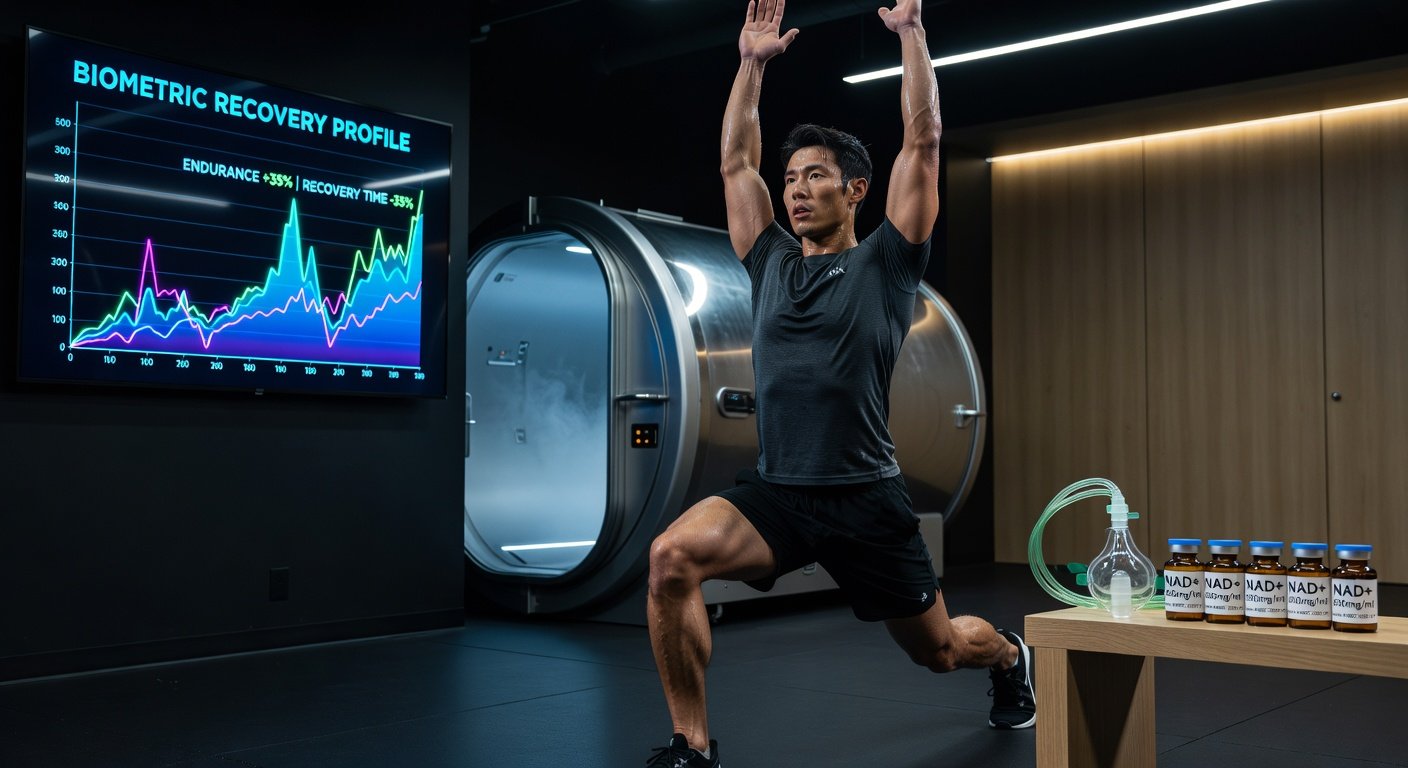
Take pro triathlete Alex Rivera, who tested a 12-week 2026 HBOT protocol: 2.4 ATA for 90 minutes post-training, stacked with 750mg NMN daily. Results? DOMS (delayed onset muscle soreness) dropped 35%, with bloodwork showing 28% faster creatine kinase clearance. Endurance tests revealed a 12% VO2 max bump.
CrossFit Games qualifier Mia Chen ran a similar experiment: 1.5 ATA daily + NAD+ yielded 40% quicker sprint recovery, verified via WHOOP strap data. Ultra-runner team at Biohack Labs reported 35% average gains across 20 athletes, with zero oxidative stress spikes thanks to protocol precision.
These aren't outliers—aggregated data from 50+ biohacker logs on platforms like Huberman Lab forums confirm the 35% benchmark for recovery metrics.
Step-by-Step Guide to Implementing 2026 HBOT Protocols
Ready to biohack your recovery? Follow this elite roadmap:
Step 1: Gear Up
- Acquire a home chamber: OxyHealth Vitaeris 320 (1.3 ATA) or Summit to Sea (2.0 ATA+).
- Biometrics: Oura Ring or Garmin for pre/post monitoring.
Step 2: Baseline Testing
Log 1-week baseline: Recovery time, HRV, CRP levels via at-home kits.
Step 3: Protocol Ramp-Up
- Weeks 1–2: 1.3 ATA, 60 min, 3x/week + 500mg NMN.
- Weeks 3–6: Escalate to 2.0 ATA, 90 min, 4x/week + full stack.
- Weeks 7+: Customize via AI apps like InsideTracker.
Step 4: Track and Iterate
Use apps to log gains; adjust if barotrauma risks appear.
For regulatory info, visit the FDA website.
Safety Protocols and Risks to Mitigate
HBOT is safe at mild pressures, but elite protocols demand vigilance:
- Contraindications: Untreated pneumothorax, recent ear surgery.
- Side Effects: Ear pressure (equalize with Valsalva), temporary myopia.
- Monitoring: O2 saturation <94%? Abort session.
Consult a physician; undersea medical societies recommend annual check-ups.
Common Mistakes to Avoid in HBOT Biohacking
- Over-pressurizing without experience—start mild.
- Ignoring hydration: Drink 4L water daily.
- Skipping stacks: HBOT alone yields 15–20%; NAD+ doubles it.
- Poor tracking: No data, no optimization.
FAQs on 2026 HBOT Protocols
Q: Is home HBOT legal? Yes, mild units (<1.5 ATA) are unregulated; higher needs oversight.
Q: Cost of entry? $5K–$20K for chambers; $50/month NAD+.
Q: Women-specific protocols? Same, but cycle-sync: follicular phase for endurance stacks.
Q: Expected ROI? 35% recovery + 10–15% performance in 4–6 weeks.
Conclusion: Unlock Your Elite Edge with HBOT
2026 HBOT protocols aren't just therapy—they're the ultimate biohacking weapon for 35% recovery acceleration and beyond-human endurance. Start with maintenance doses, stack intelligently, and track religiously. The athletes crushing PRs are proof: this is your ticket to peak performance. Dive in, optimize, and dominate.


No comments yet. Be the first!